


Pool composition and fee logic
Total stakes
The total stakes are divided into winning and losing stakes: where is the set of winners, is the set of losers, and is the stake of participant .Take rate
Trepa applies a take rate to the total volume. However, it’ll be only taken from losing stakes. The stakes of winning participants are returned without any reduction.Distributable dividend pool
The pool available for distribution to winners after fees are deducted from losing stakes.Importantly, Trepa guarantees positive ROIs to winning participants as winning stakes are refunded first before the dividend pool is distributed.
Payout allocation
Winner’s share calculation
Your payout depends on three factors.- Your stake
- Your time weight
- Your accuracy score
Time-weight
Trepa rewards participants who submit predictions early. The time weight uses a concave decay function that rewards early participation and strongly discourages deadline sniping.- Starts at the maximum bonus value for the earliest predictions
- Gradually decreases as the deadline approaches
- Reaches 1.0 (no bonus) at the deadline
Dynamic ROI cap
Trepa enforces a dynamic ROI cap to prevent outsized jackpots from near-perfect forecasts. The cap scales with the difficulty of the prediction task, a larger realistic outcome space means more potential outcome values and that leads to a greater cap. This mechanism ensures higher potential returns for harder-to-predict questions while keeping payouts bounded.Capped proportional allocation
Your gain from the dividend pool is calculated using a capped proportional rule: where:- is your gain
- is your gains cap (the maximum profit you can earn under the ROI cap)
- is the water level (a single number chosen so that the whole dividend pool is paid out)
- is your weighted stake (combines your stake, time weight, and accuracy score into one value)
Water-filling algorithm
The water level is chosen so that the gains of all winners add up exactly to the dividend pool. Trepa uses a standard water-filling process to find this level.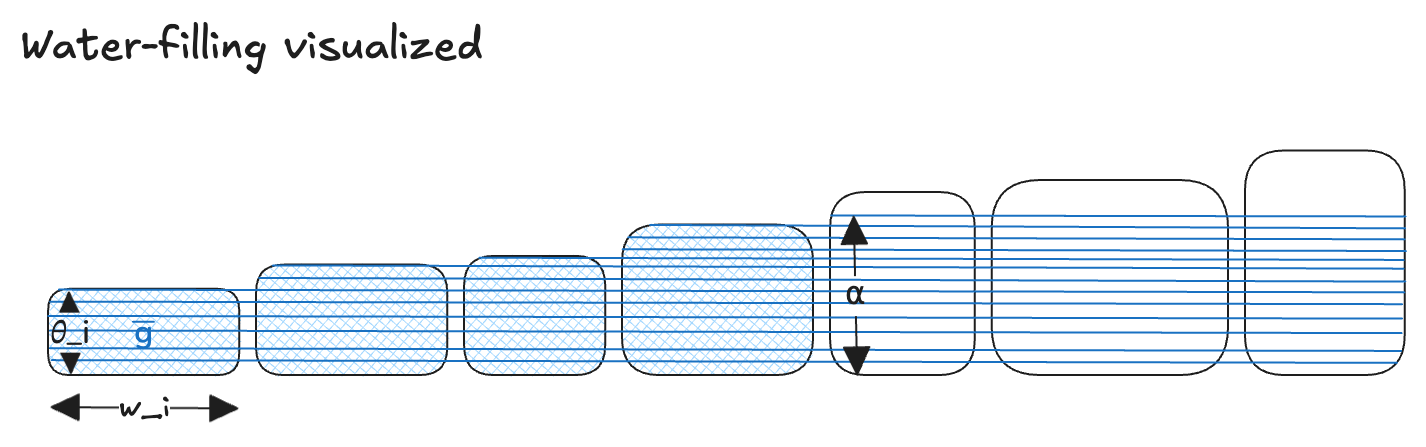
- For each winner, compute a cap ratio.
- Sort all cap ratios from smallest to largest.
- Imagine slowly raising the water level . As soon as the water level reaches a winner’s cap ratio , that winner becomes capped and stops scaling further.
- Continue raising the water level for the remaining uncapped winners until the entire dividend pool is allocated, with no leftover.
- Gains scale with weighted stakes as long as caps are not hit.
- Caps prevent any single participant from taking too large a share.
- The dividend pool is fully exhausted without any residual amount.